A Full Stop Is a Declared Gap: Provenance Already Has a Grammar for Absence, and Almost Nobody Reads It
On a collectors guide that quotes a real provenance, an expert who explains its uncertainty in prose, and the punctuation mark that had already said it
This study takes no view on the attribution of any work named in it, on where any object belongs, on restitution, return, export or origin, or on any party's title to anything. It is not investment advice and it is not legal advice. The two museum standards described below are recorded as existing; their application to any particular object is not assessed here.
A magazine published a careful explainer for collectors this month. To illustrate how an ownership history is read, it quoted one real provenance from an auction catalogue and had a former Christie's specialist walk through it. The walkthrough is accurate. It also restates, in a sentence of prose, a fact the catalogue had already stated in a single punctuation mark, and neither the expert nor the article mentions that the mark is there or what it means.
That is the finding, and it is not a complaint about the article, which is better than most. It is evidence about the field, and it is the kind of evidence worth more than an assertion, because it was produced by somebody with no interest in making this point.
What Is Established, With Its Dates
What Is Provenance, and Why Does It Matter When Buying Art? by Robin Sutton Anders was published in Veranda on 15 October 2026. Its principal source is Catherine Edmonson, who read art history as an undergraduate, took a master's at Sotheby's Institute of Art in London, spent close to a decade at Christie's New York in Trusts and Estates, and now works as an art consultant and directs the Gallery of Art and Design at the University of Southern Mississippi. The article also quotes Anthony Barzilay Freund of 1stDibs and Molly Boarati, associate curator at the Nasher Museum of Art at Duke.
Its definition is the conventional one and it is correct: "Provenance starts when an artwork was first created and continues with each owner. Every exchange creates another link in the chain." It notes that a provenance "might include a collection of letters, photography, or newspaper clippings about an exchange." It records that museums researching ownership follow standards on Nazi-era appropriation issued in 1998 and on archaeological material issued in 2008, and says those standards matter especially when there are gaps in the ownership chain or a lack of documentation.
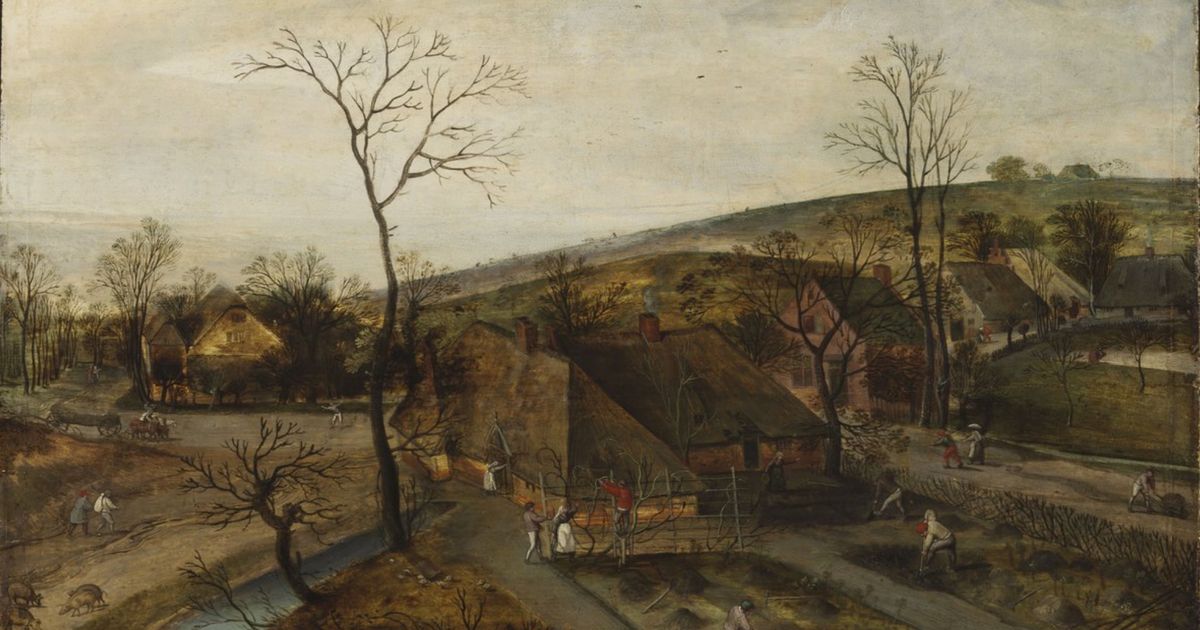
To show a reader how this looks in practice, the article reproduces the provenance of an oil painting by Jacob Grimmer from a Christie's catalogue, The Month of January, With the Sign of Aquarius:
De Vaulx Collection, France. Auguste Fourcroy (1909-1988), Brussegem, Belgium, by 1963, as 'Martin van Valckenborch'. Anonymous sale; Christie's, London, December 13, 2000, lot 2, when acquired by Alice and Nikolaus Harnoncourt.
Edmonson then explains it. Fourcroy acquired the painting in France from the De Vaulx Collection. The Chateau de Vaulx in Burgundy was linked to the Damas family, lords of Vaulx from 1471 to 1793. And then the sentence this study is about: "we can assume the Grimmer picture was there for ages, but we can't be certain."
The Grammar Exists, and a Museum in Indianapolis Publishes It
Before returning to that sentence, the convention it is unknowingly paraphrasing.
Most anglophone museums that use a provenance format at all use the one set out in The AAM Guide to Provenance Research, Washington DC, 2001. The Indianapolis Museum of Art at Newfields publishes its rules in plain language on its own collections site, and the relevant clause is one sentence:
Punctuation is used to indicate relationships between owners: a semicolon (;) is used to indicate that a work of art passed directly between two owners, and a period (.) is used to indicate that a direct transfer did not occur or is not known to have occurred.
The same page records the rest of the notation. Owners are listed in chronological order. Dealers and auction houses go in parentheses to distinguish them from private owners. Life dates of owners go in square brackets. Uncertainty is marked with "probably" or "possibly". Footnotes carry sources or clarification.
Read that clause again and notice what it does. A full stop is not the absence of information. It is a positive statement that the chain is not known to be continuous at that point. One keystroke, load bearing, published by museums on their public pages, and older than any software that has tried to read it. The institution that issued the guide has since renamed itself the American Alliance of Museums; practitioners still cite the 2001 volume under the older name, which is a small instance of a record outliving the identity of whoever wrote it.
Read the Christie's Line Again
Now apply the clause to the line the article chose to teach from.
De Vaulx Collection, France. Full stop. Under the museum convention that is a declared statement: the transfer from De Vaulx to Fourcroy either did not happen directly or is not known to have happened directly.
Auguste Fourcroy (1909-1988), Brussegem, Belgium, by 1963, as 'Martin van Valckenborch'. Full stop again. A second declared discontinuity, between Fourcroy and whoever consigned the painting to the 2000 sale. The record does not say the consignor was unconnected to him. It says only that a direct passage is not established, which is a narrower and more useful claim than either a guess or a silence.
Anonymous sale; Christie's, London, December 13, 2000, lot 2, when acquired by Alice and Nikolaus Harnoncourt. A semicolon. Direct transfer. The anonymous consignor's property passed through that sale to the named buyers with nothing missing in between.
So the line contains two declared gaps and one documented direct transfer, and it says so in three marks of punctuation. A reader who knows the clause gets all of that at a glance. A reader who does not sees a list of names with full stops in it, which looks like ordinary prose and reads as continuous.
The Prose Said Less Than the Punctuation
Set the expert's sentence beside the mark it describes.
"We can assume the Grimmer picture was there for ages, but we can't be certain." That is a true and honest statement, and it is weaker than the full stop in two different directions at once. It guesses at duration, which the record does not support: nothing in the line says how long the painting was at Vaulx, and the Damas lordship ending in 1793 is context rather than evidence of custody. And it frames the uncertainty as the speaker's own hesitancy, when the catalogue had already asserted it as a property of the record.
The punctuation is the more precise instrument and it was already in the quotation. A decade at Christie's and a Sotheby's Institute master's sit behind that sentence. This is not a knowledge failure. It is a notation that professionals write and then explain around, which is a different and more interesting problem.
And there is a second reading problem in the same four lines, which no amount of expertise resolves. Under the AAM convention parentheses mark a dealer or an auction house and square brackets mark life dates. In the Christie's line the parentheses hold life dates. Christie's is a commercial house and is not bound by a museum guide, so there is no error here. But it means the single worked example a national magazine selected is punctuated in a way that two live conventions read differently, and nothing in the article tells a reader which one applies. A human sees digits and a dash inside the brackets and disambiguates instantly. A machine cannot.
What the Notation Can Record, and What It Cannot
Here is the limit, stated precisely, because it is the whole of the opportunity.
The full stop records a gap. It cannot record a search. It tells you the chain is not known to be continuous at that point. It does not tell you whether anybody tried to establish that it was, how hard, in which archives, or when. Those are different facts, and the grammar has a form for the first and no form at all for the second.
That distinction is not pedantry. A record that says nobody has looked and a record that says three researchers looked in four archives over two years and found nothing carry the same mark and are worth entirely different amounts to a buyer, a lender, an insurer and a historian. The notation flattens them, and the only place the difference can currently live is a footnote, which is optional, unstructured and absent more often than not.
This is where Semantic Burden lands on a single character. A full stop is being asked to carry at least four meanings. Not transferred directly, not known to have transferred directly, searched and unresolved, and never examined. It has one shape for all of them. Compare Narrative Permanence, where the form of a thing survives and the reason for the form does not.
How Often the Grammar Is Used for the Hard Case
This institution has measured that question against institutional corpora, and the figures below are quoted with their denominators because a number without one is a claim.
Roughly 0.18% of provenance records declare that a search was made and failed. About one in five hundred. Measured across the National Gallery of Art's full published corpus, 81,543 records, and it replicates an independently derived figure of about 0.2% hand-coded on different institutions. The National Gallery of Art is, not incidentally, among the institutions that publish the punctuation convention on their own collection pages. The grammar is documented and the hardest thing a researcher can honestly say is said once in five hundred records.
2.75% of records name an anonymised holder instead, across the same 81,543: private collection, unidentified dealer. That is fifteen times commoner than a declared failed search, and it is the commonest way a record conceals without lying. Edmonson's own best line in the article is that what isn't listed is just as important as what is. The ratio is the measured form of her point.
99.3% of records whose custody spans 1933 to 1945 carry nothing marking the period as examined. The finding is not that nobody examined them. It is that a record examined and found clean is byte-identical to a record nobody ever opened, so the diligence is invisible to everyone downstream including the institution that performed it. This is the absent search field again, at the one period where two international standards specifically ask for the work.
3 of 10 major museums publish provenance as machine-readable data at all. The Metropolitan Museum of Art exposes it in neither its public API, 57 fields, nor its bulk dataset, 54 columns. Several large institutions publish a credit line, which answers how did we come to have this and not where has it been. Ten institutions, selected by whether they publish open data in the first place.
A Practitioner at a National Museum Says the Same Thing About His Own Institution
That last figure is ours, so it is worth setting beside somebody else's account arrived at independently.
A documentation manager and art historian at the National Gallery in London has written about the problem from inside it. His note of caution about his own employer is blunt: "We haven't published provenances as structured data, let alone visualisations." On the convention itself he writes that the AAM standard, "the standard mostly adopted by anglophone museums (if they use one at all)", is "very flexible."
And on the one serious attempt to make the punctuation machine-readable: the Carnegie Museum of Art, as part of its Art Tracks project, "drew up a much more rigid version of the AAM standard, the CMOA Digital Provenance Standard, which was capable of being parsed into structured data using regular expressions" by a tool called Elysa. Then the sentence that dates the whole field: "the standard remains stuck at version 0.2, published in 2016, and Elysa seems not to have got much further than a proof of concept."
Two derivations, two sources, one conclusion. A corpus measurement from outside and a practitioner's account from inside agree, and the agreement means something because neither was built from the other.
It also explains a number this institution produced and found uncomfortable. A parser scoring provenance text against a hand-coded corpus reached F1 of 0.05, precision 0.50 and recall 0.03, over 131 records of which 122 carried custody information. It missed 98% of the silences a human reader sees instantly. The reason is structural: a date-based method needs two dates and most provenance carries none. A rigid standard capable of being parsed exists, has existed since 2016, and sits at version 0.2.
One Thing the Article Gets Backwards, and It Is Checkable
The article's opening claim is that provenance is "the most important factor when it comes to owning and valuing art", and in the body, that "arguably, it is the most important" contributor to value.
That is testable and it has been tested on a large sample. Li, Ma and Renneboog, In Art We Trust, Management Science volume 70 issue 1, 2024, pages 98 to 127, measured documentation premiums across 1,707,136 sales. Their figures: literature coverage +53.5%, exhibition history +41.9%, pedigree, meaning the ownership chain, +20.7%, certification +13.9%.
The ownership chain is real, it is substantial, and it is the third of the four. Being written about is worth more than being owned by somebody notable. That is not a small correction to a collector's mental model, and it points somewhere unexpected: the premium attaches most strongly to the record that is easiest to make and hardest to fake, which is publication.
The paper also supplies the best single detail in this whole area. Its abstract calls pedigree the ownership "blockchain", three financial economists reaching for that word to describe a chain of custody, with no technology anywhere in the vicinity.
A Well-Described Problem With No Specified Instrument
It would be easy, and wrong, to conclude from all of this that nobody records absence. The opposite is true, and anyone working in a collection will say so within a sentence.
The AAM punctuation grammar carries absence in its syntax and predates every digital attempt at it. Art Tracks formalised it so that a sentence is one unbroken known chain and a full stop is a declared break. Archival silence is a named concept with an entry in the Society of American Archivists' own dictionary, and institutions run formal gaps analyses; the field already holds the maxim that absence of evidence is not evidence of absence. Jeremy Huggett's Capturing the Silences in Digital Archaeological Knowledge uses the word ignorance eighty-five times in twenty pages. Dark data, in David Hand's phrase, is data "that have not been recorded and remain largely hidden but which may have a major impact on subsequent use and interpretation." Paradata is data about how data was made. CCO and CDWA handle unknown as a value, and CIDOC CRM states outright that it acknowledges the intrinsic incompleteness of information about the past.
So the honest sentence is not that the problem is unrecognised. It is that a well-described problem has no specified instrument. What is missing from the list above is narrow and it is the same thing in every case: no conformance test, no retention duty, no identifier, and no field that distinguishes a gap from a search. The vocabulary is a century of careful work. The instrument is a full stop and an optional footnote.
The Last Paragraph Names the Gap Without Meaning To
The article closes by telling readers to buy from living artists they love, and it ends on an image worth keeping: "Then you can be the first in a chain of provenance that will stretch into the future, like planting a tree even though you'll never stand under its shade; your grandchildren will."
That is exactly right, and it is an instruction with no instrument attached. A reader persuaded by it has nowhere to be the first link in. No register accepts the entry. No notation exists for a first custodian recording what they know at the moment they know it, which is the one moment when the information is complete and free. The museum convention begins at an owner and a date, and assumes somebody downstream will reconstruct the rest from letters, photographs and newspaper clippings, which is the article's own list of what a provenance might contain. Every item on that list is something a later researcher hopes was kept.
This is the shape of the gap this institution has measured in a different setting too: a complete record exists for the museum-held painting and almost nothing for the contemporary object. A 1938 canvas gets four fields and a room finished last year gets two words. Not carelessness. There is nothing to record the second one into, and the convention is being applied faithfully in both cases. Object Permanence is a property of records before it is a property of things.
What a Reader Can Actually Do This Week
Three things, all free, all available to anyone reading a catalogue tonight.
Read the punctuation first. In any provenance published by a museum, and in most published by auction houses, count the full stops before you read the names. Each one is a declared break. A chain of six owners joined by semicolons and a chain of six separated by full stops look almost identical on the page and are completely different records.
Ask for the footnote. The convention puts sources and clarifications in footnotes, and footnotes are the first thing dropped when a provenance is retyped into a listing, a condition report or a press release. Ask what the footnote said. A dealer who has the answer will send it; the absence of an answer is itself a measurement.
Ask whether a search was made. This is the question the notation cannot answer and nobody is obliged to volunteer. Has anyone looked at the 1963 to 2000 interval, where did they look, and what did they find? The three possible replies are a document, no, and a change of subject, and all three are more informative than the record.
Coda
A magazine chose one provenance to teach from, and it chose well: four lines, three owners, two declared breaks and a documented sale. Its expert read it accurately and explained one of those breaks in a sentence of careful prose. The break was already stated, by a full stop, under a rule a museum publishes on its public website, and no part of the article mentions that the rule exists.
The grammar is not broken. It is unread, and it is being asked to do more than one character can. It can say that a chain is broken. It cannot say that anyone went looking, and the measured consequence is that roughly one record in five hundred admits a failed search while fifteen times as many name no holder at all.
The fix is not a better mark. It is a field, a duty to fill it, and a test that fails when it is empty. The reason to say so plainly is that every component of the diagnosis above was written down by somebody else, in a museum guide, in an archivist's dictionary, in a conservation standard and on a practitioner's blog, over roughly a hundred years. What has never been built is the thing that reads a full stop and asks the obvious next question.