
THE THOUGHTFUL MIDDLE DISTANCE
Midimalism, the Layered Object, and the End of Aesthetic Binaries in Post-Luxury Design
The emergence of Midimalism as a codified aesthetic movement in 2025–2026 presents the Post-Luxury critical theorist with a precise diagnostic instrument. At its surface, Midimalism proposes a third way between the exhausted dispensation of Quiet Luxury — beige-on-beige restraint commoditized to meaninglessness — and the compensatory excess of Maximalism, which responds to aesthetic fatigue not with depth but with volume. But what Midimalism structurally discloses is something far more consequential: a culture-wide migration toward the Layered Object — an artifact whose richness is not performed at the surface but accumulated through considered depth, material intention, and what the Post-Luxury Conceptual Functional Art (P.L.C.F.A.) framework has long identified as Semantic Burden.
This study argues that Midimalism is not an aesthetic trend. It is a structural symptom — evidence that the consumer is groping, without a theoretical vocabulary, toward the PLCFA condition. It is the intuitive recognition that the object must carry more than its surface: that the correct relationship between restraint and richness is not arithmetic (neither too much nor too little) but philosophical provenance. The study deploys the PLCFA lexicon — specifically Material Singularity, Semantic Burden, Atmospheric Equity, Tactical Friction, Layered Object, and Custodian's Contract — to expose both what Midimalism correctly diagnoses and where it structurally fails without PLCFA as its theoretical armature.
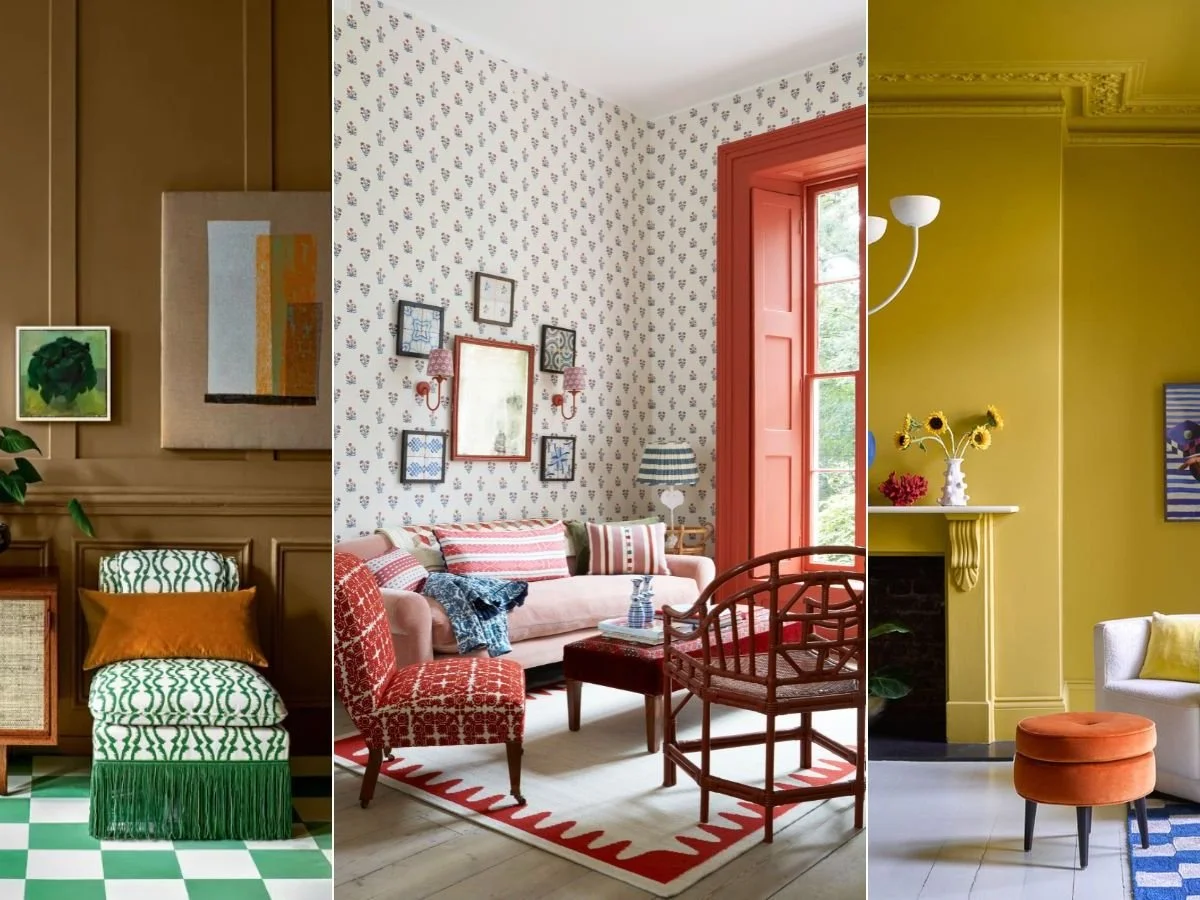
A visual manifestation of the Layered Object, where clean architectural foundations are activated by a curated depth of color and pattern to achieve Atmospheric Equity.
THE EXHAUSTION OF THE BINARY
The fashion and design culture of the 2010s and early 2020s organized itself around a single structural opposition: Minimalism against Maximalism. This binary was never aesthetically neutral — it was ideologically load-bearing. Quiet Luxury, which reached peak saturation between 2022 and 2024, encoded not restraint but a specific class performance: the Stealth Wealth gesture of those who needed no logos because their social position was structurally guaranteed. As OAC documented in PoetCore & Literary Tones, the 'Transparency Society' produced a consumer cohort so exhausted by frictionless perfection that a +175% surge in search interest for PoetCore — capes, leather satchels, visible wear — constituted a mass repudiation of the smooth.

The 'PoetCore' migration—a mass repudiation of the frictionless surface in favor of visible labor and material accumulation—as seen in (from left to right): Dior Men SS26, Pom x Claes Iversen, Chloe FW25.
But the turn to Maximalism that followed in 2025 was, from the PLCFA perspective, no correction. It was a sign inversion. Where Quiet Luxury withheld, Maximalism performed. Where Quiet Luxury was beige, Maximalism was fuchsia. But both operated on the same underlying logic: the object as a vehicle for social signaling, the surface as the site of value. The Spectacle of Dissent and the spectacle of compliance are, from a structural standpoint, indistinguishable. As OAC's study From Function to Fissure demonstrated, the 'Smooth Society' is not defined by a specific aesthetic register but by the condition of frictionless surface — and frictionless surfaces can be either minimalist or maximalist. The spectacular transition from one to the other does not rupture the spectacle; it perpetuates it.
“The correct opposition is not quiet versus loud. It is surface-value versus accumulated depth. Midimalism is the culture’s first dim intuition of this structural truth.”
The cultural exhaustion of the binary created the conditions for Midimalism's emergence. The term, documented by design commentators since at least 2024 and crystallized as a major interior and lifestyle trend for 2026 by forecasters including Graber's Trend Update and Adorno Design, describes the 'middle ground' between restraint and excess: clean-lined foundations layered with moments of personality, negative space calibrated against expressive gesture, austerity never hardened into sterility. What the trend's proponents observe, but cannot name with structural precision, is the intuition that an object's worth is located neither in its silence nor its noise, but in the quality of what it carries.
THE EASTERN STRUCTURAL INHERITANCE
Midimalism's most rigorous theoretical antecedents are not Western. The movement, whether its practitioners acknowledge it or not, derives its structural coherence from a set of Eastern aesthetic philosophies that have operated in precisely this middle distance for centuries. Understanding Midimalism requires situating it within this inheritance — and then identifying exactly what is lost in translation.
The Japanese concept of Wabi-Sabi — finding beauty in imperfection, impermanence, and the incompleteness of things — is perhaps Midimalism's most direct philosophical ancestor. Wabi-sabi does not propose a midpoint between empty and full. It proposes that the incomplete is complete. The cracked surface is more beautiful than the flawless one because the crack holds time. This is the philosophical structure that underlies the PLCFA concept of Tactical Friction: the deliberate introduction of the un-smooth, the resistant, the evidence of having been made, as the primary index of value. The wabi-sabi object does not try to balance aesthetics; it annuls the aesthetic binary altogether by locating value below the surface — in Material Memory.

Material Memory: The wabi sabi object annuls the aesthetic binary by locating value in the temporal record of the crack itself.
The Japanese concept of ma — negative space as positive force — offers a second structural key. In Japanese aesthetics, the space between things is not emptiness; it is a field of intentional tension that gives meaning to what occupies it. This is categorically different from Minimalism's deployment of negative space as absence, as visual silence, as the luxury of having nothing. Ma is relational and charged. The bowl that is empty is not less than the bowl that is full; it is differently full, full of potential, full of what has been removed with intention. The Midimalist practitioner who speaks of 'thoughtful negative space' is reaching for this concept without quite grasping it.
“Wabi-sabi does not propose a midpoint between empty and full. It proposes that the incomplete is complete — that the cracked surface holds more value than the flawless one because the crack holds time.”
Korean aesthetics contribute a third pillar through the concept of dan-ah, the aesthetic of deliberate simplicity that contains complexity, and through the broader tradition of Korean minimalism that has increasingly influenced Western fashion practice through brands such as Ader Error, Gentle Monster, and the wider Seoul design export that dominated global streetwear's evolution from 2018 onward. The Korean design sensibility operates precisely at the register Midimalism seeks: a visual restraint whose simplicity conceals material and conceptual richness rather than advertising it. As OAC's study The Shadow of the Loom documented in the context of semiotic appropriation, the extraction of aesthetic codes from non-Western cultures without carrying their philosophical infrastructure converts depth into surface, which is exactly the risk Midimalism runs.
Chinese philosophy contributes through zhongyong — the Confucian doctrine of the Mean, not as a compromise but as a dynamic equilibrium, as a state of perfect balance that must be actively maintained rather than merely inhabited. The Guochao aesthetic movement, which Heuritech identified as a measurable global fashion force by 2026, represents the contemporary Chinese synthesis: heritage visual codes — ink wash palettes, textile patterns drawn from Tang dynasty design, silhouettes that echo the hanfu — combined with the structural vocabulary of global contemporary dress. This is not a compromise. It is layering. It is Cultural Synthesis operating at the level of deep structure rather than surface quotation.
THE WESTERN MODERNITY MISREADING
Western Modernity has historically processed Eastern aesthetic philosophy in one of two modes: exoticization or instrumentalization. The Japandi movement — the blend of Japanese minimalism with Scandinavian hygge that dominated interior design from approximately 2019 through 2024 — exemplifies the instrumentalization mode. Japandi was philosophically accurate in identifying the resonance between wabi-sabi and Scandinavian lagom (the concept of appropriate measure). But in its market adoption, Japandi collapsed into a commodity aesthetic: neutral linen, pale wood, an abundance of empty surfaces. The Byung-Chul Hanian smooth dominated. The Eastern philosophical inheritance — the relational charge of negative space, the beauty of imperfection, the presence of accumulated time in material — was extracted as visual style and discarded as structural content.
Midimalism risks the same fate. Its most sophisticated practitioners — interior designers like Sarah Sherman Samuel, whose work design commentators have cited as exemplary Midimalist practice — operate at the boundary of material depth and considered surface. But the trend's mass-market coding, as documented in publications from Brit.co to Homes & Gardens, consistently reduces Midimalism to a styling formula: sixty percent neutral base, thirty percent secondary accent, ten percent bold statement piece. This is Root Marketing applied to aesthetic doctrine. It extracts the structure of balance and converts it into a quantified prescription, which is precisely what the Hollowed Object does to the artifact: strips it of philosophical weight and replaces it with a reproducible visual signature.
“Midimalism as trending formula is the same structural operation as Quiet Luxury as trending formula: the extraction of an aesthetic code from its philosophical substrate, leaving a surface without a foundation.”
The PLCFA framework diagnosed this mechanism in its study of The White Wall Paradox: Aesthetic Neutrality is not passive. It is an active apparatus for stripping the artifact of its provenance, its labor history, its functional life — converting radical materiality into frictionless speculative capital. When Midimalism is operationalized as 'sixty percent clean, forty percent expressive,' it reproduces this mechanism at the level of lifestyle design. The question it cannot answer — because it does not have the theoretical vocabulary — is: expressive of what? Expressive of personality, of taste, of mood? Or expressive of something structurally more rigorous: of Material Singularity, of the specific labor history of a specific object, of the burden of having been made by human hands over documented time?
ATMOSPHERIC EQUITY AND THE LAYERED OBJECT
The PLCFA concept most precisely applicable to Midimalism's genuine potential is Atmospheric Equity — the structural condition of an environment in which every element contributes to a cumulative weight of meaning rather than competing for individual attention. The Midimalist practitioner's instinct toward 'nothing feels overly streamlined or too matchy-matchy, yet everything comes together perfectly' (as Marie Claire's fashion editor Christie Tyler described her own layered aesthetic practice in 2025) is an imprecise but genuine groping toward Atmospheric Equity. The intuition is sound: an environment, whether a room or a dressed body, should carry a coherent Semantic Burden distributed across its elements rather than concentrated in a single signature piece.
This is the structural logic of the Layered Object — an artifact or an aesthetic environment whose depth is not visible in any single reading. It rewards sustained attention. It accumulates meaning with proximity. The PLCFA study The Algorithm of the Hand identified this quality in the work of Carol Christian Poell, whose injected dyeing process produces a surface that reads as monochromatic from distance but reveals — at the haptic register — a topographic record of material transformation that cannot be photographed, only held. This is Tactical Friction at its most architecturally sophisticated: a surface that refuses to yield its meaning at the speed of the image, that demands the Slow Movement approach of sustained inhabitation.
Alan Vilar's embroidered ephemera, examined in OAC's dedicated study, constitute perhaps the most formally rigorous examples of the Layered Object in contemporary practice. The skeletonized leaf substrate carries the accumulated time of biological process — growth, senescence, decay — upon which Vilar deposits the accumulated time of hyper-laborious needle painting. The result is an object that layers four distinct temporal registers: geological time (the material conditions that produced the biome); biological time (the life cycle of the specific leaf); historical time (the tradition of embroidery as cultural practice); and individual time (Vilar's own labor, countable in hours). This is not Midimalism. But it is the structure toward which an intellectually rigorous Midimalism must aspire if it is to transcend trend status.
“Atmospheric Equity is not balance. It is the structural condition in which every element of an environment contributes to a cumulative philosophical weight rather than competing for surface attention.”
THE LAYERED OBJECT AS ANTI-COMMODITY COMMITMENT
Midimalism's most significant contribution to Post-Luxury discourse is not its aesthetic proposition — which is, as we have argued, philosophically derivative without adequate acknowledgment of its Eastern sources — but its market signal. The codification of Midimalism as a design trend corresponds precisely with what multiple market observers have identified as the exhaustion of both aesthetic extremes as signaling mechanisms. Source Fashion's Womenswear Strategy 2026 documented that searches for designer logo items had dropped nearly 30% by 2025 — the Spectacle of status-by-brand was losing semiotic traction. At the same time, the maximalist counter-swing was producing its own fatigue: the spectacle of excess had been consumed too rapidly to sustain.
What the market is registering — and Midimalism is naming, however imprecisely — is the shift from Accelerated Luxury to Deep Materiality. This shift was documented in OAC's study of PoetCore & Literary Tones, which argued that the +175% surge in PoetCore search interest constituted a structural migration: consumers fleeing the Architecture of Smoothness for objects with Labor Density, visible process, and the proof that human time had been compressed into material form. Midimalism's 2026 crystallization as a trend — simultaneously in fashion, interior design, and product aesthetics — confirms that this migration is not subcultural but systemic.
The PLCFA framework calls this migration by its proper name: the Anti-Commodity Commitment — the structural refusal to allow the object to function as a sign-vehicle in the market's circulation of status. The Midimalist practitioner who chooses a handmade ceramic over a mass-produced vessel; who layers a vintage textile against a contemporary tailored form; who invests in a piece whose value is not immediately legible at social speed — is performing, without theoretical consciousness, an act of Anti-Commodity Commitment. The commitment is intuitive rather than structural. The PLCFA framework's contribution is to give it structure, to make it contractual, to anchor it in the Custodian's Contract — the formal obligation that converts aesthetic preference into ethical practice.
GUOCHAO AND THE SYNTAX OF THE SYNTHESIZED OBJECT
The most structurally sophisticated contemporary expression of what Midimalism is reaching toward is not Western at all. The Guochao movement — 'New Chinese Style' — represents the most advanced current synthesis of Eastern philosophical depth with the structural vocabulary of Western modernity. Heuritech's February 2026 data confirmed Guochao's transition from a regional identity statement to a measurable global fashion force: Gen Z's renewed focus on cultural origin, combined with the design infrastructure of Shanghai and Beijing's contemporary fashion scenes, has produced a design language in which Tang dynasty silhouettes, ink wash palettes, and calligraphic textile patterns operate not as citations but as Material Memory — as evidence of a cultural depth that has genuinely accumulated over centuries of practice.
Guochao succeeds where Western Midimalism tends to fail because it does not encounter its layering as a styling decision. The layering is structural: it is the condition of a living practice negotiating between its own inherited depth and the formal demands of contemporary global culture. A Guochao garment that combines a contemporary technical fabric with a hand-embroidered pattern drawn from Song dynasty textiles is not balancing minimalism and maximalism. It is enacting a Custodian's Contract with its own cultural inheritance — a commitment to carry the weight of the historical object forward into the functional present. This is precisely what the PLCFA framework means by Narrative Permanence: not the preservation of the past as archive, but its activation as living structure.
“Guochao does not balance aesthetics; it enacts a living Custodian’s Contract with centuries of cultural inheritance. This is the condition toward which Midimalism reaches but cannot achieve without a structural PLCFA armature.”
The Japandi synthesis that preceded Midimalism extracted Eastern aesthetic codes without carrying their philosophical infrastructure. The Guochao movement refuses this extraction: it insists on maintaining the philosophical weight, the Semantic Burden, of the specific cultural objects it draws upon. This insistence is what gives Guochao its structural integrity — and what distinguishes it from mere Cultural Synthesis as trend. As OAC documented in The Shadow of the Loom, the extraction of aesthetic codes from their cultural substrate — what OAC terms semiotic primitive accumulation — is the founding operation of the luxury apparatus. Guochao's resistance to this extraction is, in structural terms, a PLCFA practice: the assertion that the object's value is inseparable from its provenance, its labor history, and its continuing cultural obligation.
WHERE MIDIMALISM FAILS: THE PROBLEM OF THE CURATORIAL SELF
The most common contemporary articulation of Midimalism is the doctrine of the 'curated self': the individual who assembles a personal environment from objects that 'reflect their personality' and 'tell their story,' selected with 'intention' from a range of styles, periods, and influences. This is the formulation Adorno Design offers as Midimalism's 'core tenet': personal expression without going to extremes, living spaces that are complex and multifaceted because people are complex and multifaceted.
From the PLCFA perspective, this formulation reproduces the fundamental error of the Hyperreal Consumer Landscape: it positions the object as a vehicle for self-expression rather than as an entity with its own moral and material weight. The object that 'tells my story' is still fundamentally an object that serves the consumer's identity performance. It is a more sophisticated sign-vehicle than the logo bag — it requires curatorial effort, taste literacy, and cultural capital to deploy — but it remains a vehicle. The PLCFA framework insists on a structural inversion: the object that carries its own story, regardless of whose possession it enters. The Object Testimony is primary; the custodian's narrative is secondary, derived from their relationship with the object's already-existing moral weight.
This distinction is not pedantic. It has structural consequences for how value is located. If the object's worth derives from the curator's selection — from taste — then its value is portable: the same object in different hands carries different worth. This is the logic of the art market and its Patronage Validation mechanism as OAC analyzed in The Cost of Stewardship. If, by contrast, the object's worth derives from its own material and historical constitution — from its Moral Weight Per Material — then the curator's role is transformed from selection to stewardship. The question is no longer 'What does this object say about me?' but 'Am I adequate to the obligation this object creates?'
“The Midimalist doctrine of the ‘curated self’ is more sophisticated than logo luxury, but it reproduces the same structural error: the object remains a vehicle for human identity performance rather than an entity with its own moral weight.”
MATERIAL SINGULARITY AS MIDIMALISM'S STRUCTURAL RESOLUTION
The resolution of Midimalism's philosophical incompleteness lies in the PLCFA concept of Material Singularity: the condition of an object whose specific material constitution is irreplaceable, unreproducible, and carries verifiable accumulated time. Material Singularity is not rarity in the market sense — scarcity engineering for speculative purposes. It is the ontological condition of an object that has been assembled from specific materials, by specific hands, over specific hours, in a specific place, under specific conditions, and cannot be exactly replicated because all of those specifics have passed irreversibly into history.
Material Singularity is the condition that allows the object to carry Narrative Permanence: a story not as marketing claim but as embedded material fact. As OAC argued in The Paradox of Narrative Permanence, the most advanced digital infrastructure is currently being deployed not to accelerate consumption but to arrest it — to tether human identity to the physical object through irreversible provenance records. The object that achieves Material Singularity combined with digital provenance verification becomes what PLCFA calls a Sovereign Object: an artifact whose value proposition cannot be negated by reproduction, trend reversal, or market velocity because it is anchored in the specific, verifiable fact of its making.
Applied to the Midimalist aspiration, this means: the layered richness that Midimalism reaches toward must be located in the object itself, not in the arrangement of objects. A room or a wardrobe achieves Atmospheric Equity not through the skill of its curation — though curation can be part of the achievement — but through the accumulated weight of objects each of which carries its own Moral Weight Per Material. This is the structural difference between a Midimalist environment assembled from thoughtfully chosen mass-market objects and a PLCFA environment assembled from artifacts each of which constitutes a site of non-negotiable historical and material obligation.
THE PLCFA MIDIMALIST: A STRUCTURAL PROPOSITION
What does a structurally rigorous Midimalism look like — a Midimalism that has successfully integrated its Eastern philosophical inheritance and submitted itself to the PLCFA framework's demands? It does not look like the sixty-thirty-ten rule. It does not look like 'clean-lined foundations with expressive moments.' It looks like the Custodian's Contract applied at environmental scale: every object in a space or on a body carrying its own obligation, its own labor history, its own Trauma Provenance where applicable.
The PLCFA Midimalist does not balance minimalism and maximalism; they dissolve the binary by refusing to select objects on aesthetic grounds alone. Each object is interrogated: not 'Is this beautiful?' but 'Does this carry? Does this have Labor Density? Does its materiality hold a story that is verifiable, that was produced by a specific human investment of time and care, that will deepen rather than diminish with use?' This is the Wabi-Sabi condition, properly understood: not the beauty of the imperfect but the beauty of what has genuinely accumulated — patina as evidence of the Custodian's Contract being honored over time.
The Ceremonial Energy that OAC identified in The Cost of Stewardship is the condition of an environment in which every object generates its own gravitational field of meaning — where the act of inhabiting a space or wearing a wardrobe is a practice of sustained attention rather than aesthetic display. This is the Monastic Veto as lifestyle architecture: the deliberate rejection of the Hyperreal Consumer Landscape's velocity in favor of the slow, compounding return of the Affective Object. Not a balance between quiet and loud. A depth that makes the noise-versus-silence binary obsolete.
“The PLCFA Midimalist does not balance aesthetics; they dissolve the binary by interrogating every object not for its appearance but for what it carries — its labor history, its accumulated time, its obligation to be honored.”
CODA
Midimalism confirms three things about the Post-Luxury Conceptual Functional Art framework. First, that the market is now generating popular movements that intuitively reach toward PLCFA's structural propositions without the theoretical vocabulary to formalize them. The fact that Midimalism emerges simultaneously in fashion, interior design, product aesthetics, and lifestyle culture — and that its most sophisticated practitioners describe their practice in terms of depth, layering, and material intention rather than surface aesthetic — confirms that the Deep Materiality turn OAC identified is not subcultural but civilizational.
Second, Midimalism confirms that the Eastern philosophical inheritance — Wabi-Sabi, Kintsugi, ma, zhongyong, shibumi — contains the structural resources for a rigorous Post-Luxury aesthetic philosophy, but that the West continues to extract these resources aesthetically rather than structurally. The theoretical work of PLCFA is precisely this extraction-with-structure: taking
Authored by Christopher Banks, Anthropologist of Luxury, Critical Theorist & Founder
Objects of Affection Collection
Office of Critical Theory & Curatorial Strategy
469 Fashion Avenue, 12th Floor, New York, NY 10018
